

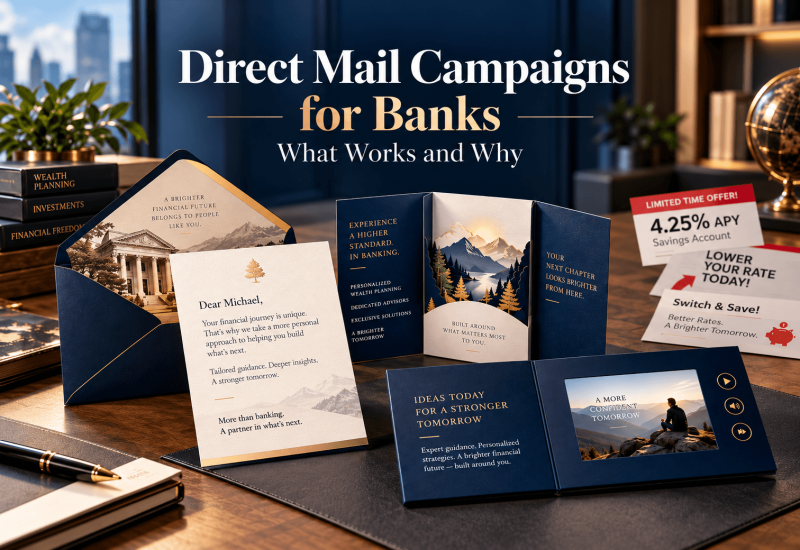
Direct mail works best for banks when it looks special, not like the rate-promo postcard sitting on top of the recycling pile. Most retail bank mail still arrives as flat cards with an APR and call to action, which reads as junk before the recipient's hand even finishes turning it over. What moves the needle is a piece built to survive the first three seconds of interaction: something dimensional or video-driven that a decision-maker actually picks up and opens, aimed at an audience narrow enough to justify the extra production cost. This shift is behind much of the strongest creative direct mail coming out of financial services right now, and it explains why banks that used to mail everyone are mailing fewer people but doing a better job of it.
What Makes Direct Mail Work for Banks
The format your mail takes should match the stakes of the relationship, not the size of the mailing list. A retail rate promo going to ten thousand households is a volume game. A letter going to a wealth-management client, a referral partner, or an advisor network is a different kind of mail entirely, reaching a high-stakes recipient who is already primed to judge the bank on the quality of everything it sends. Banks getting real results from mail right now are the ones matching their pieces to that second category and treating them as part of the pitch.
Why Do Banks Still Use Direct Mail in a Digital-First World?
A physical piece of mail skips the two filters that email imposes: the spam folder and the recipient's own habit of scanning past a marketing message. Businesses advertise by mail because it lands in a mailbox instead of an inbox, where it competes with far less for a moment of attention. This attention is crucial in banking because opening an account, moving assets, or picking an advisor is a decision based on trust, and a well-made piece of mail signals more investment in the relationship than an email ever could. In terms of response volume, financial marketers routinely report that a dimensional or video piece outperforms a flat mailer or email, though any bank testing the channel should measure its own numbers rather than assume a result.
What Direct Mail Formats Work Best for Banks?
Direct bank mail earns its higher production cost through the format doing something a flat card cannot. The three formats that show up most in financial campaigns each solve a different problem.
Video Brochures and Video Mailers
A video brochure involves a small screen built directly into the mail piece, so a recipient presses play the moment it opens instead of clicking through to a landing page later on. Video brochures and video mailers are useful for product explanations, annuity walkthroughs, wealth-management pitches, or anything communicated at a personal register, which a rate table or PDF attachment just can't deliver.
Dimensional and Pop-Up Pieces
A structural, pop-up piece trades video for a physical reveal, the flap that springs open or the panel that unfolds into something remarkable. It fits a lighter-touch moment: a brand launch, a referral thank-you, or an event invitation where the goal is to be remembered and picked back up. After switching from a #10 envelope mailer to a pop-up cube, Hanover's auto and home insurance quote response rates increased by 40%. It’s a good reminder that a small shift in physical form can yield a massive return on engagement.
Personalized, Variable-Data Letters
A well-designed, data-personalized letter still has a place in bank mail, especially for higher-volume touches like a cross-sell offer or a statement insert, where the cost per piece has to stay low. The format works when the personalization is specific (the account, the balance tier, the branch) rather than a mail-merge name swapped into generic copy.
Who Is Bank Direct Mail Actually For?
Inside banking, dimensional mail earns its cost with a narrow, high-value audience rather than a mass consumer list. Wealth-management firms use it to onboard or re-engage a client whose account is worth protecting. Regional banks and smaller investment-banking firms use it for advisor and broker communication, an audience that pays close attention to what lands on their desk. Retail account-opening promotions, the highest-volume mail a bank sends, tend to stay with a lower-cost printed piece, because the economics of a premium format only work when the list is small and the relationship justifies the extra cost.
Brighthouse Financial is one example of that math working: the insurer reported a 40% lift in annuity revenue sold through independent advisors after using video brochures for product education.
What Compliance Rules Apply to Bank Direct Mail?
Bank direct mail carries disclosure obligations that flat retail mail doesn't. Any piece advertising a deposit account, an interest rate, or a fee falls under Regulation DD, the Truth in Savings rule issued by the Consumer Financial Protection Bureau. This rule determines how a rate, minimum balance, or fee must be disclosed.
A piece that references deposit insurance carries a separate rule. The FDIC's advertising requirements for insured status govern how the FDIC name and logo can be used and bar language that misrepresents what is and isn't insured. A marketing team producing a bank mailer should route the copy through compliance before it goes to print.
How Should Banks Measure a Direct Mail Campaign's Success?
Measure your bank's success as you would any other acquisition or retention channel: against a defined action (an opened account, a booked meeting, an advisor referral) tracked back to the piece through a code, URL, or call-tracking number. Response and ROI figures for dimensional mail get cited a lot, but they move with list quality, offer strength, and audience fit, so you're better off treating them as starting points to test against, not promises.
By requesting a free sample pack, your marketing team can experience our paper stock, screen, and build quality firsthand. Weigh it against whatever flat mail your bank already runs and get a real feel for it before you place an order.