

Direct mail continues to prove that physical marketing can deliver powerful results in a digital world. While inboxes are crowded and online ads compete for attention, a well-designed mail piece creates a moment that recipients actually notice.
For agencies and marketers, the key question is not whether direct mail works. The real question is how to measure direct mail ROI and maximize the return from every campaign.
Understanding the return on investment of a direct mail campaign allows marketing teams to improve targeting, refine messaging, and generate more leads with each mailing. When campaigns are tracked correctly, direct mail becomes one of the most measurable and dependable marketing channels available.
In this guide, we will explore the most important metrics for measuring direct mail ROI, strategies that influence performance, and practical ways agencies can improve results with every campaign. You can also explore real examples of how agencies have driven results with direct mail at our agency marketing successes page.
Why Direct Mail ROI Is Important in Your Marketing Strategy
Return on investment is one of the most important metrics in any marketing strategy. It shows whether your campaign is generating more value than it costs to run.
For direct mail campaigns, ROI helps answer several key questions:
-
Did the campaign generate new leads or customers
-
Did it strengthen relationships with existing clients
-
Did it produce measurable revenue
Unlike many digital impressions that disappear instantly, direct mail often stays on desks, refrigerators, or office spaces for days or even weeks. This longer lifespan increases brand recall and improves engagement.
Data from the Data & Marketing Association shows that direct mail can achieve response rates of up to 9% for house lists and around 5% for prospect lists. In comparison, many digital channels produce response rates below 1%.
Because of this higher engagement, direct mail often delivers stronger returns when campaigns are properly targeted and tracked.
What Are the Key Direct Mail ROI Metrics You Need to Track?
Tracking the right metrics is essential for measuring the success of your direct mail campaign. These metrics fall into three main categories.
Cost Metrics
Total Campaign Cost
This includes every cost associated with the campaign. Printing, design, mailing list acquisition, postage, and production all contribute to the total investment.
Cost Per Mailpiece
Divide the total campaign cost by the number of mail pieces sent. This helps marketers understand how much it costs to reach each contact.
Performance Metrics
Delivery Rate
The percentage of mail pieces successfully delivered to recipients. Accurate mailing lists help maintain a strong delivery rate.
Response Rate
This measures how many recipients take action after receiving the mail piece. Actions may include visiting a landing page, scanning a QR code, or contacting a sales team.
Conversion Rate
Conversion rate tracks how many respondents become leads or customers. This metric is critical for determining campaign effectiveness.
Outcome Metrics
Return On Investment
Return on Investment (ROI) compares the revenue generated by the campaign to the total campaign cost.
The formula is straightforward:
ROI = (Revenue Generated - Campaign Cost) ÷ Campaign Cost.
Customer Lifetime Value
Customer Lifetime Value measures the long-term revenue generated from each customer acquired through the campaign. A campaign may deliver strong ROI over time, even if the initial purchase is modest.
5 Key Factors That Can Influence Direct Mail Return On Investment
Several strategic decisions can influence the performance of a direct mail campaign.
How To Select The Right Target Audience
The most important factor in direct mail ROI is the audience. A well-segmented mailing list dramatically improves response rates.
Agencies should focus on building targeted lists using customer data, industry information, and past engagement behavior. The more relevant the message is to the recipient, the more likely they are to respond.
Personalization vs Generic Mailers: Which One Is Better?
Personalized mail consistently outperforms generic messaging. Variable data printing allows marketers to customize names, images, offers, and messaging for each recipient.
When a mail piece feels relevant to the reader, it is far more likely to capture attention and generate action.
When And How Often You Should Mail
Timing plays a major role in campaign performance. Sending mail during key seasonal periods or industry events can increase engagement.
Consistency is also important. One mailing may create awareness, but multiple touches help move prospects through the sales funnel.
How To Choose the Right Copy and Design
Design and messaging must work together to communicate value quickly.
Clear headlines, engaging visuals, and a strong call to action help guide the reader toward the next step. Simplicity often performs better than overly complicated layouts.
Which Mail Piece Delivers the Best ROI
The format of your mail piece can influence engagement and response rates.
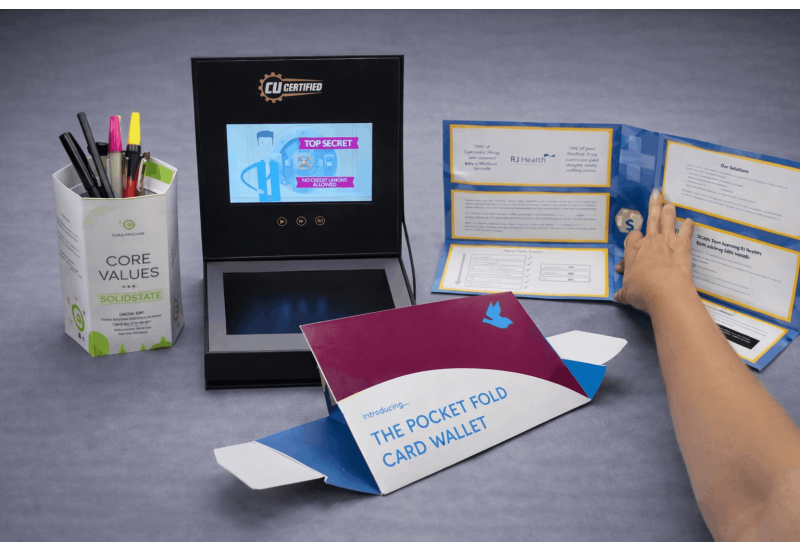
Standard postcards are cost-effective and easy to distribute at scale, making them a solid choice for broad awareness campaigns or high-volume prospecting. However, when the goal is to stand out and drive a specific action, dimensional mail and interactive formats consistently generate stronger response rates because they create an experience the recipient did not expect.
Pop-up mailers and fold-out formats are particularly effective at the top of the funnel, where the priority is to grab attention and make a memorable first impression. Their tactile nature encourages recipients to engage with the piece rather than set it aside.
For mid-funnel and high-value prospects, video brochures combine the physical impact of print with embedded video, giving your message a premium feel that signals a genuine investment in the relationship.
Dimensional mailers and custom packaging take that a step further, creating an unboxing moment that is difficult to ignore and even harder to forget. These formats tend to perform especially well in account-based marketing campaigns where the audience is small and the stakes are high.
Red Paper Plane specializes in innovative direct mail formats designed to increase engagement and improve campaign performance.
How to Accurately Track Your Direct Mail ROI
Modern direct mail campaigns can be tracked with impressive precision.
-
QR codes allow recipients to quickly access landing pages using their mobile devices, giving you an immediate signal of who engaged and when.
-
Tracking codes and personalized URLs (PURLs) help identify which recipients responded to the campaign, making it straightforward to attribute results to a specific send.
-
Dedicated landing pages capture form submissions and record visitor behavior, turning each response into a measurable data point.
-
CRM integration connects campaign responses directly to sales activity and revenue, giving agencies a clear line of sight between a mail piece and a closed deal.
These tools transform direct mail from a traditional marketing channel into a measurable performance channel that provides actionable campaign analytics.
Direct Mail vs Digital: Which Channel Delivers Better ROI?
Digital marketing offers speed and scale, but it also faces challenges such as ad fatigue and crowded inboxes.
Direct mail provides a physical experience that stands out.
Data from the Data and Marketing Association show that direct mail response rates can reach 9% for house lists and around 5% for prospect lists. Email campaigns often have average response rates below one percent.
Direct mail also benefits from stronger brand recall. Research consistently shows that people remember physical advertising for longer periods than digital ads.
This does not mean marketers should choose one channel over another. The strongest campaigns often combine direct mail with digital marketing in a multichannel strategy.
For example, a direct mail piece may introduce a brand while QR codes and landing pages guide recipients into digital engagement.
Planning a Campaign? Use This Checklist to Maximize Your ROI
Agencies looking to maximize direct mail ROI should follow several key steps:
-
Start with a clean and well-segmented mailing list.
-
Develop a compelling offer that provides real value to the recipient.
-
Choose a format that stands out and captures attention.
-
Include a clear call to action that makes it easy to respond.
-
Track campaign performance using QR codes, landing pages, and CRM systems.
Innovative formats from Red Paper Plane can help agencies create memorable campaigns that generate higher response rates and stronger engagement.
When creative formats are paired with strong targeting and measurable tracking methods, direct mail becomes a powerful driver of marketing ROI.
Frequently Asked Questions
What is the average ROI for direct mail?
Direct mail campaigns can generate strong returns depending on targeting and execution. Research often cites returns between 29% and 40%, with some campaigns achieving even higher returns.
How do you calculate ROI for direct mail?
ROI is calculated by subtracting the campaign cost from the revenue generated, then dividing the result by the campaign cost. This reveals how much profit was generated for each dollar spent.
What is a good conversion rate for direct mail?
Conversion rates vary by industry and audience. Many campaigns see conversion rates between 2% and 5%, while highly targeted campaigns may perform even better.
What is the average engagement rate for direct mail?
Direct mail engagement rates are typically higher than digital advertising. Response rates can range from 5% to 9%, depending on audience targeting and campaign quality.