

You have probably seen a strong campaign underperform for reasons unrelated to the creative. The targeting was right. The message was tight. The follow-up sequence was built. And still, the people you most needed to reach never engaged, because the channel itself could not get through.
That is the problem experiential direct mail is built to solve. A video mailer, a dimensional package, or an interactive piece does something a campaign in the inbox cannot: it lands in the recipient's hands. They have to pick it up and decide what to do with it. That decision alone is more engagement than most digital campaigns ever earn from a senior buyer.
What Makes a Mail Piece Experiential
Most direct mail delivers information. A postcard announces an offer. A brochure explains a service. A letter introduces a company. The recipient reads it, sets it aside, or recycles it. The transaction is one-way and over in a few seconds.
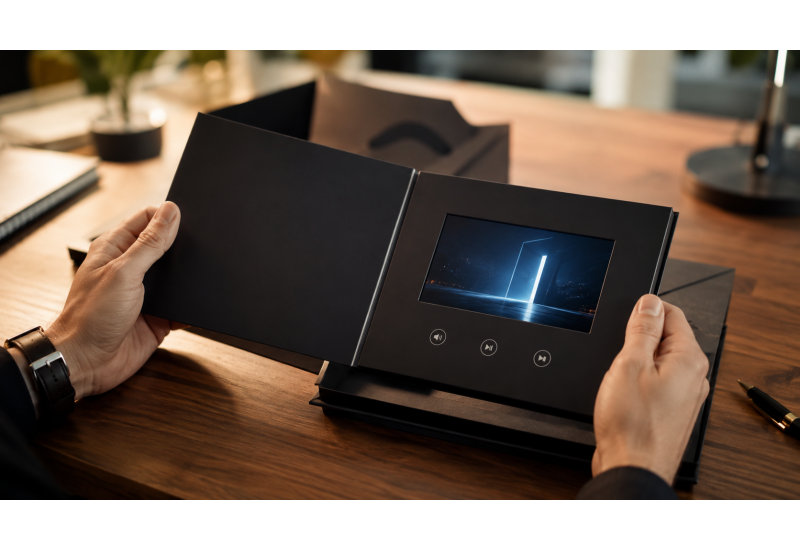
An experiential piece works differently because it asks the recipient to do something before the message lands. A mailer opens into a three-dimensional display. A tab pulls back to reveal the offer. A wheel rotates through product benefits. A box contains a sample, an invitation, or a premium insert wrapped in a way that makes opening it feel deliberate. A video mailer starts playing a product story, executive message, or event invitation the moment the cover lifts.
That small act of interaction is the whole point. The recipient is no longer scanning a message; they are participating in one. And the few seconds of focused attention that creates is the part of the campaign you cannot buy through any other channel.
What Happens When the Piece Lands
A physical campaign behaves differently from a digital one once it reaches the recipient, and the difference is worth understanding before you decide what to send.
A piece of mail enters a real space. It sits on a desk, a kitchen counter, or a credenza. It is handled, moved, sometimes passed to a colleague. That extended presence is something email and paid media cannot replicate — a message in the inbox has roughly the lifespan of a scroll, while a mail piece can stay in front of the recipient for days. Neuromarketing research from the USPS Office of Inspector General and Temple University found that physical advertising produced stronger memory, longer engagement, and greater activity in brain regions associated with value and purchase intent than digital advertising did.
An experiential piece amplifies that effect because the recipient is not passively looking at it. They are opening, unfolding, pulling, or watching. That physical involvement is what turns a campaign touchpoint into something the recipient can actually recall a week later when your sales team follows up.
This is the part of the math that matters most. A campaign does not need to reach everyone. It needs to be remembered by the people you most need to reach. A mail piece that earns sixty seconds of focused attention and another thirty seconds of recall a week later is doing the job that most digital impressions never finish.
What Separates a Strong Piece from an Expensive Mistake
The format is not what makes an experiential campaign work. The match between the format and the message is what makes it work, and the wrong match is the fastest way to spend real money on something the recipient throws away.
A product launch usually benefits from motion and sound, because a new product is easier to understand when the recipient can see it demonstrated rather than described. That points toward a video mailer. A trade show invitation often benefits from a dimensional format, because the act of unboxing builds the kind of anticipation an email cannot. A campaign aimed at a financial services audience often benefits from restraint, heavy stock, clean print, and an understated open, because the signal you want to send is credibility, not spectacle.
The format should reinforce what the campaign is asking the recipient to feel, understand, and do. When it does, the piece earns its place in the budget. When the format is chosen for its own sake, because pop-ups are clever or because video is impressive, the recipient registers the cleverness and sets the piece down without acting on it.
Three questions are worth answering before signing off on any experiential campaign. What should the recipient feel in the first five seconds after opening it? What should they understand by the time they set it down? What should they do next, and how quickly should they be able to do it? If the format does not serve clear answers to all three, the piece is decoration. If it does, the piece is doing work the rest of your stack cannot do.
Where Experiential Direct Mail Works Best
Experiential direct mail is most effective when the audience is valuable, the message requires attention, and the next action matters.
The first is audience value. The recipient list must be small enough and important enough to justify a more deliberate touchpoint. A campaign to 200 named accounts, 500 conference invitees, or a top tier of donors fits this. A campaign to 50,000 cold prospects does not.
The second is message weight. The campaign has to be carrying something that benefits from being held, watched, or unfolded. A product launch with a story to tell, an executive message that needs to come from a real person, an invitation that needs to feel like an invitation, a pitch that needs to outlast the meeting it was sent before.
The third is that the next action matters. The recipient is being asked to schedule a meeting, attend an event, renew a commitment, or make a decision that moves real revenue. When the next step carries that kind of weight, a piece that earns focused attention is doing work the rest of the campaign depends on.
When all three conditions line up, the math works. The piece is being sent to people whose attention is worth earning, carrying a message that benefits from physical delivery, and in a situation where recipients are led to take action.
Why Video Mailers Earn the Most Attention Per Send
Of all the experiential formats, a video mailer gives you the most control over the first impression.
A video mailer is a printed piece with a built-in screen that begins playing the moment the recipient opens the cover. The screen, the speaker, the packaging, and the message arrive as one coordinated piece. The recipient does not have to click a link, find an email, or visit a landing page before the story starts. The story is already playing in their hands.
That matters more than novelty. A video mailer lets you decide what the recipient sees, hears, and feels first. Your product demo runs at the right pace. Your executive message lands in the executive's actual voice. Your pitch reel plays the way you intended, on a screen the recipient is actively holding. None of that is guaranteed when the same content is sent as a link.
The format earns its place in campaigns where the message is harder to carry in print alone. A complex product becomes easier to explain when the recipient can see it working. An executive outreach piece becomes more personal when the recipient can hear the person speaking. A high-stakes pitch becomes more memorable when the recipient watches the reel before the meeting rather than during it. A donor appeal becomes more affecting when the story is told in the voice of the person it is about.
If you are targeting a small list of accounts that need to act, a video mailer is one of the few formats that delivers a complete brand moment in a single touchpoint. The recipient opens the piece, the message plays, and the call to action is already on the page before them.
How to Make Your Experiential Direct Mail Campaign Measurable
A physical campaign is only as defensible as the data behind it. Before the first piece ships, build the tracking into the design.
The mechanics are straightforward. A personalized QR code on the piece routes each recipient to a campaign-specific landing page. A personalized URL does the same for recipients who type rather than scan. A unique phone number, offer code, or campaign tag in your CRM closes the loop on the recipients who respond through other channels. Most campaigns use two or three of these in combination, so you can track the response regardless of how the recipient prefers to act.
The setup matters more than the mechanic. A QR code only works if the landing page it leads to is built for this campaign, not pointed at a generic product page. A personalized URL only works if the page on the other side recognizes the recipient and continues the conversation the mailer started. A unique phone number only works if the person answering it knows what campaign the caller is responding to. Tracking that is bolted on after the creative is finished tends to produce numbers you cannot defend.
Once the tracking is built in, you get the kind of data you can take into a quarterly review. A video mailer sent to 200 named accounts can show you how many recipients scanned, which accounts responded, how many meetings were booked, which opportunities moved into the pipeline, and which closed. That is the same chain of evidence to which the rest of your marketing stack is held. When the chain holds, the program gets renewed. The point of building measurement in from the start is not just to prove the campaign worked. It is to give you a defensible answer the next time the budget conversation comes up.
How the Direct Mail Fits Into the Rest of Your Campaign
A physical campaign performs best when it is not running alone.
The most effective sequence treats the mailer as the focal point, with digital channels doing the warm-up and the follow-through. A LinkedIn or display campaign to the target account list a week or two before the drop puts your brand in front of recipients before the piece arrives, so the mailer lands as recognition rather than a cold introduction. After the piece lands, an email or a sales outreach call references it directly, because a follow-up that names the mailer reads as continuity, and a follow-up that ignores it reads as a different campaign from a different team. Retargeting reaches recipients who engaged with the landing page but did not convert, keeping the brand present while the decision works its way through whatever internal process it must go through.
The mailer is the moment your campaign is most likely to be remembered. Everything before it is preparation, and everything after it is conversion. When the sequence is built that way, the physical piece does not have to carry the campaign on its own, and the digital channels do not have to do a job they were never going to do well.