
The stretch between an acceptance letter and a paid deposit is where enrollment yield is won or lost, and a crowded inbox rarely wins it. Direct mail for higher education improves enrollment yield by putting a tangible, personalized, well-timed piece in a student's hands. It tends to lift the application, campus-visit, and deposit rates that email alone leaves on the table. Our creative direct mail is built for exactly those moments. Here is how mail moves the numbers, format by format.
Why Direct Mail Still Works for Higher Education Enrollment
Direct mail still works for higher education because physical mail gets opened at rates email cannot match, and an opened piece is the first requirement for any response. According to ANA/DMA research, households open roughly 80 to 90 percent of the mail they receive, while marketing email open rates sit near 20 to 30 percent.
According to the Association of National Advertisers, direct-mail response rates run around 4.4 percent, compared with about 0.12 percent for email. That is a gap of roughly 36 times per piece sent. For an enrollment office competing for attention against every other college emailing the same senior, that difference is the whole argument.
Do Prospective Students Really Respond to Direct Mail?
Yes, prospective students respond to direct mail, and younger students respond more than most marketers expect. According to USPS Generational Research, 57 percent of 18- to 34-year-olds find direct mail extremely or very useful, the highest share of any age group. Even among Gen Z, 86 percent sort through their physical mail.
Postalytics and EnvyPak report the same pattern in enrollment marketing, where students assumed to live online still open the mail. A tangible acceptance letter or a dimensional viewbook lands differently than the fortieth email of the day.
What Does Enrollment Yield Mean, and How Does Direct Mail Move It?
Enrollment yield is the share of admitted students who go on to enroll, calculated as students enrolled divided by students admitted. According to the National Association for College Admission Counseling, the average yield rate at four-year colleges has fallen from 36 percent in 2014 to 30 percent in 2022. Every admitted student now converts less reliably than a decade ago.
Direct mail moves yield by re-engaging admits and prospects at the exact decision points email misses: the moment an application is due, the week an acceptance arrives, the quiet summer before move-in.
How Does Direct Mail Reduce Summer Melt?
Direct mail reduces summer melt by keeping admitted students engaged through the deposit-and-paperwork window when many quietly disappear. In their book Summer Melt, researchers Benjamin Castleman and Lindsay Page found that 10 to 20 percent of accepted students who intend to enroll never show up in the fall. That figure climbs toward 40 percent among low-income and community-college-bound students.
They also found that low-cost summer outreach measurably keeps those students on track. A physical nudge in July is exactly the kind of touch that research supports. Mail reaches the admit who has stopped checking a student portal they do not yet feel is theirs.
Which Direct Mail Formats Drive the Best Response?
The direct mail format that drives the best response depends on where a student sits in the funnel and what the budget allows, from budget brochures built for reach to premium dimensional pieces built for high-value admits.
Budget Brochures
Brochures are the low-cost, storytelling format for early awareness. A budget brochure can introduce a campus or program to a large audience of prospective students, making it an ideal choice for recruitment campaigns that prioritize broad reach and budget efficiency. With ample space for compelling photography, student testimonials, academic highlights, and campus life, brochures help institutions communicate their unique value in a way that's both informative and engaging.
Dimensional and Interactive Mailers
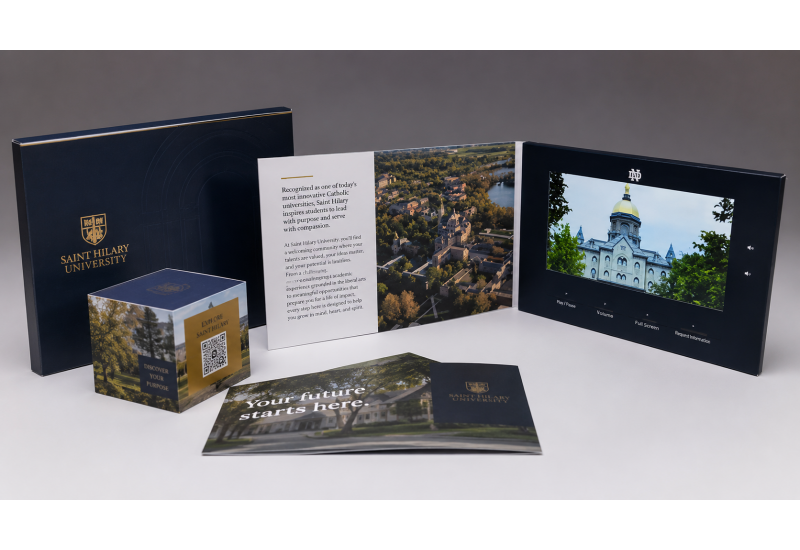
Dimensional and interactive mailers are the standout tier, the pieces that open, pop up, play video, or drop a student into a virtual campus tour. This is the format built to be kept and remembered. Our video brochures put a screen and a campus welcome directly in a student's hands, and VR viewers deliver an immersive campus tour to admits who cannot travel to visit. A pop-up piece turns an acceptance into a moment worth photographing.
Welcome and acceptance packages are the admit-to-enroll format, the physical piece that turns an acceptance into a deposit. A premium package makes a student feel chosen rather than processed. Think of a well box holding a video, a gift, and a QR code to the admitted-student portal. A promotional well box is built for exactly this acceptance-stage moment.
Sul Ross State University saw a 26 percent increase in admission applications after mailing a dimensional recruitment piece, as detailed in its case study. A separate California Lutheran University acceptance packet drove a 50 percent QR-scan rate to a welcome video and admitted-student portal. Yield is won in this envelope.
How Does Personalization Increase Engagement?
Personalization increases engagement because a piece addressed to a student's name, intended major, and hometown reads as relevant rather than bulk. Variable-data printing lets a college print a different name, program, and image on every piece in a single run. Personalized URLs then send each student to a landing page built for them.
Industry research puts the lift at roughly 135 percent when a mail piece is personalized by name and printed in full color. The same research found that 84 percent of consumers say they are more likely to open personalized mail. A prospective psychology major should see psychology, not a generic campus shot.
When Should You Send Direct Mail in the Enrollment Cycle?
You should send direct mail at the enrollment cycle's decision points, meaning the inquiry stage, the application window, the moment of acceptance, and the weeks before a deposit is due. A single mailing rarely decides anything, so most effective campaigns use three to five touches spread across the year and timed to the academic calendar. An early piece builds awareness, an application-window piece drives submissions, and a post-acceptance piece protects yield.
The send that matters most for yield is the one after acceptance, through the summer, when a student is deciding whether the school is truly theirs.
How Do You Combine Direct Mail With Digital Outreach?
You combine direct mail with digital outreach by making each channel point at the other. QR codes and personalized URLs link a printed piece to a landing page, an application, or a deposit form with a single scan. An email a day or two after a mailing lands reinforces the same message while it is fresh. Retargeting keeps the school visible online to the students who received the piece. Pop-up mailers are built for this bridge. A printed QR code takes a student from the piece to a trackable page with a single scan. To a student, it feels like one school showing up everywhere that matters.
How Do You Measure Direct Mail ROI and Yield Impact?
You measure direct mail ROI by tying trackable codes to real enrollment outcomes, then calculating the cost per applicant, per visit, or per deposit. Unique QR codes, personalized URLs, and offer codes let a college trace an application back to the exact piece that prompted it.
Capture Higher Ed studied 12 college clients. It found that postcards sent to the top 30 percent of predicted-to-enroll students, deciles 8 through 10, produced roughly one additional applicant per 84 postcards at 45 cents each. That works out to about 38 dollars per additional applicant. Trifolds cost more, about 88 dollars per applicant at one per 104 pieces at 85 cents. The takeaway is to target the top deciles rather than blanket-mail the whole list. A simple A/B test on format, timing, or message turns each campaign into evidence for the next.
What Direct Mail Mistakes Hurt Enrollment Campaigns?
The direct mail mistakes that hurt enrollment campaigns are almost always about execution, not the channel: bad list data, generic messaging, a weak call to action, or poor timing. Mailing everyone instead of the top-decile students the data flags wastes budget. Capture's numbers show it is better spent narrowly.
Skipping the post-acceptance window leaves the summer-melt leak wide open. Sending an unpersonalized piece throws away the response lift that relevance buys. A weak or missing call to action leaves a student with nowhere to go after they open the piece.
The campaigns that work look the opposite, with a clean list, a personalized message, a clear next step, and a send timed to a real decision. Good direct mail for higher education is precise, not loud.
Bringing Higher Education Direct Mail Together
Direct mail improves higher education enrollment yield when the format, personalization, timing, and tracking all point to the same decision: a student choosing to enroll. The creative direct mail line is built for the moments that decide yield, from well boxes and video brochures to VR viewers for admits. Our higher-education direct mail solution covers the full program. Our free sample pack is a no-cost place to start. Yield is won one well-timed piece at a time.