

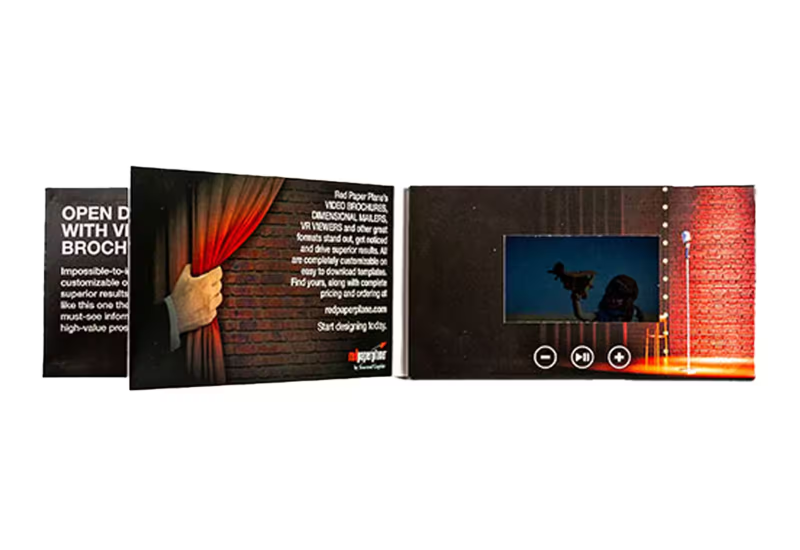
Attention is the scarcest currency in B2B, and a video brochure is built to capture it at first contact. It puts a working screen in a decision-maker's hands, so the piece gets opened, kept, and passed around a room instead of deleted in a scroll. Businesses use video brochures to close high-value deals, launch and demo products, invite VIPs, train teams, prove results, raise funds, and win attention at events. A quick-ship video brochure can be in the mail in days rather than weeks. Here are the seven smart ways, and what makes each one work.
What Is a Video Brochure?
A video brochure is a printed booklet or card with a built-in HD LCD screen, a speaker, and a rechargeable battery. It plays a video the moment it is opened, with no app and no internet required.
The screen wakes on the first page turn, and the built-in controls let the reader pause, replay, and skip between clips. You load the video over USB, no app or internet required, and the battery recharges the same way. A single piece can be reused across meetings. That combination of real hardware and printed page is what lets the format feel like a gadget and mail like a brochure.
7 Smart Ways Businesses Use Video Brochures to Win
Businesses put video brochures to work across seven high-value plays, and each one earns its place a different way.
Close High-Value Deals With Personalized Sales Pitches
Businesses use a video brochure to close high-value deals by putting a tailored pitch directly in the prospect's hands. A printed deck sits in a pile, and an emailed PDF waits for a click that rarely comes. A video brochure plays the moment it is opened, so the pitch runs on the buyer's schedule and carries the core sales message without waiting on a follow-up click.
Sales teams reach for them on enterprise proposals, executive briefings, and any deal large enough to justify a memorable leave-behind. The piece can carry the founder's voice, the product in motion, and the one proof point a slide cannot convey.
Financial services is one of the industries that leans most heavily on premium direct mail, and it's one of the markets we serve most. A held, personal pitch is a natural fit for a wealth or advisory conversation.
Launch Products and Demo Complex Offerings
Companies use video brochures to launch products and demo complex offerings that a photo cannot explain. Real estate developments, medical devices, industrial equipment, and new technology all make more sense in motion than on a spec sheet. A short demo video shows the thing working at the exact moment the buyer is holding it.
The format travels well through a buying committee. One piece can move from the champion to the engineer to the procurement lead, and each person sees the same clean demo instead of a forwarded link that breaks.
Healthcare and patient-education campaigns fit the same pattern, since a device or a treatment tends to be easier to trust once a viewer has watched it in use.
Send Premium Event Invitations and VIP Experiences
Brands use video brochures as premium event invitations that signal the event is worth attending. A gala, a product launch, or an executive conference lives or dies on turnout, and a screen-in-an-envelope invitation stands apart from the email blast every other host is sending.
The video sets the tone before the guest arrives. It can carry a personal welcome, a highlight reel from last year, or a first look at the venue.
That sense of occasion can lift response by raising the perceived value of the invitation.
Train and Onboard New Employees
Organizations use video brochures to train and onboard new employees with a format people are more likely to keep. A printed manual gets shelved, but a brochure that plays onboarding videos, product walkthroughs, and service protocols invites a replay. For any hands-on role, seeing a task performed often lands better than reading the steps.
The piece works as a self-contained kit a new hire can revisit at their own pace, with no login and no missing link. Recruiting teams use the same idea to court hard-to-reach candidates, sending a branded video pitch a cold email could never match.
Prove Results With Client Testimonials and Case Studies
Companies use video brochures to prove results by turning testimonials and case studies into something they can hand across a table. A customer telling their own story on screen can carry more weight than the same quote printed on a slide. The proof travels with the pitch instead of living on a landing page the buyer may never visit.
A single piece can hold two or three short case studies, each tied to a result the prospect cares about. That makes it portable social proof, ready for the exact moment in a meeting when a buyer asks who else you've worked with.
Drive Fundraising and Donor Engagement
Nonprofits and institutions use video brochures to drive fundraising by making a donor feel the impact of a gift. A capital campaign or an alumni appeal asks someone to give, and a short film of the students, patients, or families served makes the ask concrete in a way a letter cannot.
Higher education is a natural home for this, from alumni stewardship to major-gift cultivation. A campaign built on higher-education direct mail can pair a personal video from the dean with the printed case for support. That gives development teams a piece that stands out in a crowded mailbox.
Win Attention at Trade Shows and Conferences
Exhibitors use video brochures to win attention at trade shows and conferences with a leave-behind that outlasts the booth. Much conference swag gets tossed before the attendee even leaves the city, but a working video screen stands out from the pile, and it's a piece people show a colleague. That extra life is where the follow-up conversation starts.
On the show floor, the format doubles as a lead magnet, since a demo that plays in hand pulls people in. After the event, it keeps the pitch alive on the prospect's desk long after the badge scan is forgotten.
What Makes Video Brochures So Effective?
Video brochures work because they combine physical presence, motion, and sound, three things a single-channel ad cannot deliver at once. The effect is measurable, and it shows up in both memory and response.
They Engage Sight, Sound, and Touch
A video brochure reaches the reader through several senses at once: the printed page they hold, the video they watch, and the audio they hear. That combination matters, because information the brain takes in through more than one sense at the same time tends to be remembered better than the same message delivered through a single channel. A working screen tucked into a printed piece is built to do exactly that.
They Boost Recall and Response
Physical media is remembered better than digital, and it can drive stronger buying intent. According to a USPS Office of Inspector General study with Temple University, printed ads produced a stronger emotional response and better memory than digital ones, and they activated the brain region tied to desirability. The research looked at physical advertising broadly rather than video brochures specifically, but it supports the wider value of tangible marketing.
Our video brochures consistently achieve high response rates, though results move with the audience, the offer, the creative, and the follow-up. For the Bank of Greenwich, a video brochure campaign drove a 92 percent response rate.
They Feel Premium and Get Shared
A video brochure feels like a gift, not a flyer, so it gets kept and passed to the people who make decisions. It needs no device and no internet. It works the instant it lands, and it keeps working every time someone reopens it.
How Much Do Video Brochures Cost?
Video brochures cost more upfront than standard print because each unit is real hardware, including an HD LCD screen, a rechargeable battery, a memory chip, and custom print and finishing. The higher response and the longer shelf life usually offset that first-look difference.
Price moves with a few choices, mainly screen size, order quantity, finishes, and turnaround. There are two practical lanes to plan around. Quick Ship turns pieces around in seven to ten days, while the Flex Save options allow more customization over a four- to five-week window at a lower price. The fastest way to decide is to hold one.
Request a sample deck and feel how a screen, a page, and a finish come together before committing to a run.
How Do You Measure a Video Brochure Campaign?
You measure a video brochure campaign the same way you measure any trackable mailer, by building a unique response path into the piece. A handful of tracking methods make the results countable: a QR code that points to a campaign landing page, a personalized URL for each recipient, a dedicated phone number, and a one-time promo code. Each one ties a specific reply back to the person who received the piece.
USPS Informed Delivery adds another layer. It emails recipients a grayscale preview of incoming mail and the delivery date, and advertisers can add a clickable color image alongside it. A follow-up can then be timed to the day the brochure lands. A personalized path like this is easier to tie back to a specific reply than a generic mailer, since a promo code or PURL built for one recipient has nowhere else to go.
Choosing the Right Video Brochure for Your Campaign
Choosing the right video brochure comes down to matching the format to the campaign. Screen size runs from about 4.3 inches up to 7 inches and beyond. Turnaround splits between Quick Ship and Flex Save. Finishes range from matte and gloss to soft touch, foil, and embossing.
Use our video brochure buyer's guide to learn additional information.