

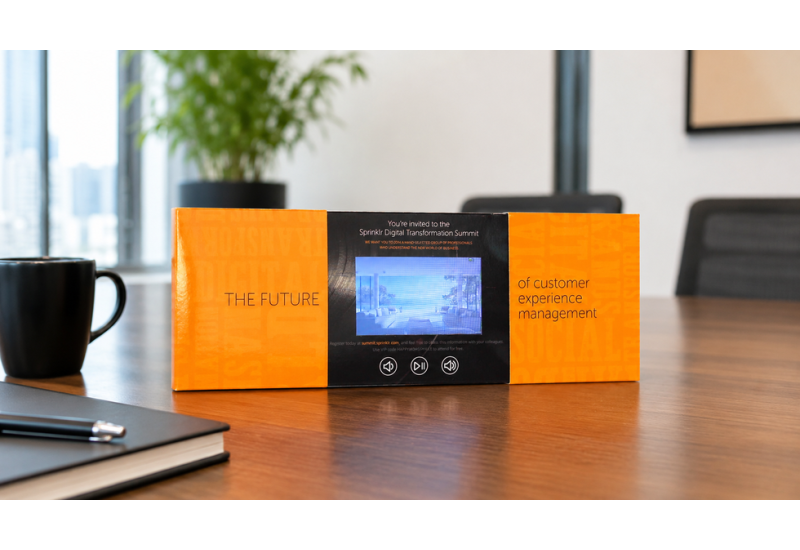
If you have ever mailed something that hit the recycling bin within ten seconds, a video mailer solves the opposite problem. People keep them, replay them, and pass them around the office. The pieces that drive response and ROI get the fundamentals right. That means a tight, story-driven video; a clean design that lets the screen be the star; the right screen size; the right way to mail it; prompt follow-up; and real tracking. The Quick Ship Video Mailers we test and inspect in-house are made for exactly that kind of high-stakes send, and this guide covers the video mailer best practices behind a stronger campaign.
What Is a Video Mailer, and Why Does It Work?
A video mailer is a printed mailer with a built-in LCD screen and speaker. It auto-plays a preloaded video the moment it is opened and runs on a rechargeable battery. It belongs to the wider family of creative, dimensional mailers that use physical format to earn attention, and the screen sets it apart.
The reason it works runs deeper than novelty. According to research from the U.S. Postal Service Office of Inspector General and Temple University, physical ads drive a stronger emotional response, are remembered better, and activate the brain's ventral striatum. That region is tied to value, desirability, and purchase intent.
Canada Post's neuromarketing research points in the same direction, finding that physical media requires 21% less cognitive effort to process and lifts brand recall by about 70% compared with digital. A screen in an envelope turns that advantage into motion and sound.
Start With a Clear Objective and Know Your Audience
The first video mailer best practice is to do this before you design anything. Choose the single outcome you want and the exact person you want to reach. Define one goal, such as booked demos, event RSVPs, qualified leads, or donations. Then name the specific audience behind it.
In B2B, that is usually a Creative Director, a Marketing Director, or another decision-maker who screens most of what reaches their desk. Every later choice, from script length to screen size to budget, flows from that objective and that reader. A mailer built to book demos from agency creatives looks nothing like one built to steward university donors.
Craft Video Content That Earns the Watch
The video is the star, and the print around it exists to get it opened. That makes the content the highest-leverage decision in the campaign. What matters most is how long it runs, how it tells its story, and how it asks for the next step.
How Long Should the Video Be?
Keep the video focused. Shorter videos generally retain a higher share of viewers, so lead with the main point immediately. If you have more to say, split it into multiple buttons so the viewer can choose what to watch, rather than sitting through one long clip.
Tell a Clear Story and Lead With Emotion
Tell one clear story on three beats. Cover who you are, what you do, and how you solve the viewer's problem. Keep it conversational, not corporate. Put a real person on camera when you can, because a human face carries more than a voiceover on stock footage. Lead with emotion rather than specs, since the feeling the video creates is what actually moves a viewer to act.
Close With One Strong Call to Action
End on one clear call to action, not three competing ones. Ask for a single next step, like scanning a code, visiting a personalized page, or calling a number. Tie that action to the trackable element you will measure later, so the moment of highest interest points straight at something you can count.
Design the Piece So the Video Is the Star
Design the printed piece to frame the screen, not compete with it. Keep the layout clean, reinforce your brand with logo and colors, and let negative space guide the eye toward the video. Strong video brochure design follows one rule above all. The print earns the open, and the screen does the rest.
The finish signals importance before the video ever plays. A premium tactile surface signals to a recipient that this is not junk mail. That is why finishes like Matte and Gloss, plus Soft Touch and Extra Tough lamination, are worth the upgrade on a high-value send. The way the piece feels in someone's hands is part of the message.
Make the Unboxing an Experience
The first impression starts at the envelope or box, before the screen is even visible. Coordinate the outer packaging with the piece inside. Add complementary collateral like a sell sheet or a QR card only where it earns its place. Custom packaging beats a carrier-branded box here, because a branded arrival reads as a considered gift rather than another parcel.
What Screen Size Should You Choose?
Match the screen size to your message, your budget, and your mailing cost, not to whatever looks most impressive. A larger screen, up to about 10 inches, is more immersive but also makes the piece heavier and bulkier.
That weight matters at the mailbox. Heavier, thicker mail moves into a higher weight and size band, and postage is priced by exactly those bands. A bigger screen therefore raises the cost of every piece. A larger glass screen is also more fragile in transit.
Screen size is therefore a trade-off between impact, mailing cost, and durability. A compact option like the 4.3-inch Extendo Video Brochure supports up to 20 minutes of video across multiple files while keeping the screen format compact. A protective box is worth considering whenever you need to shield a larger screen.
Get the Delivery Method Right
How you mail a video mailer is part of the creative, not an afterthought. Custom packaging protects your design and reads less like junk than a plain carrier-branded box. That helps preserve the open and response rates the campaign depends on.
Protect the screen on the way there, too. A dedicated video mailer box shields the electronics and glass in transit, so the piece arrives working rather than cracked in a mail tray.
Follow Up While the Impression Is Fresh
Plan the follow-up before the first piece ships. A video mailer is the opener of a sequence, not a one-and-done, and the campaigns that convert treat it that way.
Start inside your own building. Make sure everyone who might field a reply, by phone or email, has actually seen the piece and knows what it is. This is the most overlooked step in most campaigns, and the cheapest to fix. Then reach out within days of delivery, while the impression is still fresh. Keep your calls, emails, landing pages, and retargeting active during the campaign's response window.
How Do You Measure a Video Mailer Campaign's Success?
Measure a video mailer campaign by tying every piece to a trackable action. Give each recipient a clear, countable next step, such as a personalized URL, QR code, unique landing page, or dedicated phone number. Those response paths connect the mailer to real leads, conversions, and sales. That is how you calculate ROI instead of guessing.
One piece can also generate multiple impressions. Recipients replay video mailers and pass them around, so a single send can reach several decision-makers within a single account. Set your benchmarks before launch, and judge the campaign on the business it drives, not on how many pieces went out the door.
Where Video Mailers Deliver the Best Results
Video mailers are best suited to high-value, hard-to-reach audiences where you can measure performance by qualified responses, meetings, and resulting revenue.
That economic logic points directly to B2B campaigns. A video mailer costs more per piece than a brochure, but it can justify that investment on a small, precise list where one additional meeting or account creates meaningful value.
The best fits share that profile. They include account-based marketing and high-value prospect outreach, product and service launches, event and conference invitations, and executive or C-suite outreach that reaches people who ignore most channels. Higher-education alumni and donor stewardship use the format the same way, to make supporters feel genuinely seen. In each case, the piece is expensive precisely because the audience is worth it.
How Much Do Video Mailers Cost?
A video mailer costs more than flat print, and the price scales with screen size, quantity, and the degree of custom. A larger screen, a smaller run, and heavier customization all push the per-piece cost up. That is the honest answer, and also the wrong number to fixate on.
The better question is cost per qualified response. Because a video mailer can be replayed and shared within an account, evaluate the campaign against the meetings, leads, and revenue it generates rather than the unit price alone. On the right list, a single closed account can pay for the entire send.
The cleanest way to price your own campaign is to see and hold the product first. Request a physical sample deck or talk through a quote for your list. Let the numbers come from a real piece and a real audience, not a generic price tag. Get those video mailer best practices right, and the cost question answers itself.